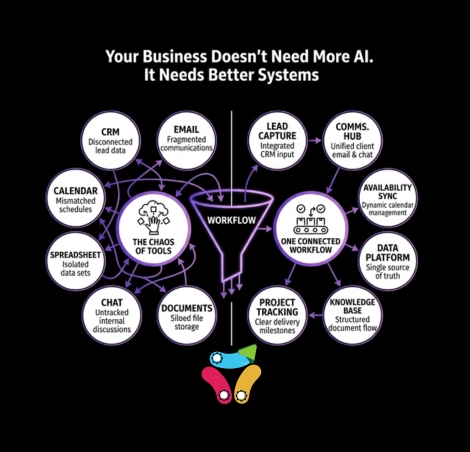
Your Business Doesn’t Need More AI. It Needs Better Systems.
Every week, a new AI tool appears promising to revolutionize the way businesses operate.
Write content faster.
Automate your emails.
Generate reports instantly.
Build AI agents.
Replace employees.
Scale infinitely.
For many business owners, the result isn’t excitement anymore—it’s exhaustion.
You’ve probably signed up for tools, watched tutorials, experimented with prompts, and wondered whether any of it is actually making your business run better.
If that sounds familiar, you’re not the problem.
The problem is that most businesses are being told to adopt AI before they understand the processes they’re trying to improve.
The Wrong Question
Most people start with:
“How can I use AI in my business?”
That sounds reasonable, but it’s actually the wrong place to begin.
A better question is:
“What repetitive work is slowing my business down?”
Because AI isn’t the goal.
Automation isn’t the goal.
The goal is reducing friction.
The goal is helping your team spend less time on repetitive tasks and more time on work that creates value.
A Lesson From the Early Internet
When websites first became popular, businesses rushed to get online.
Nobody advertised that they were an “Internet-powered company.”
The internet was simply a tool.
What mattered was the business.
A website helped businesses communicate better, reach more customers, and operate more efficiently.
Today, AI should be viewed in exactly the same way.
Your customers don’t care whether you use AI.
Your team doesn’t need another complicated platform.
What matters is whether your business operates more effectively.
AI is simply one tool among many that can help make that happen.
The Real Problem Isn’t AI
Most businesses already have more technology than they need.
Email platforms.
CRMs.
Project management tools.
Calendars.
Spreadsheets.
Cloud storage.
Communication platforms.
The issue isn’t a lack of software.
The issue is that these systems often don’t work together efficiently.
Information gets copied manually.
Tasks get forgotten.
Updates happen in one system but not another.
Employees spend hours moving information from one place to another.
The result is operational friction.
And operational friction is expensive.
Not because it causes dramatic failures, but because it slowly consumes time every single day.
Five minutes here.
Ten minutes there.
A few manual updates.
A forgotten follow-up.
An onboarding task that gets delayed.
Multiply that across a week, a month, or a year, and the cost becomes significant.
Better Systems Before Better Technology
Before introducing AI, businesses should first understand their workflows.
A workflow is simply a series of steps required to complete a task.
For example, when a new client signs up, your team might:
- Create onboarding documents
- Save them to cloud storage
- Email them to the client
- Update the CRM
- Update a sales spreadsheet
- Notify the delivery team
That is a workflow.
When those steps happen manually, they consume time and create opportunities for mistakes.
When they are connected intelligently, the entire process becomes faster, more reliable, and easier to manage.
That’s where automation and AI can help.
Not by replacing people.
By supporting them.
The AdvForLess Approach
At AdvForLess, we follow a simple framework:
Audit
We identify repetitive work, bottlenecks, and areas where your team is spending time on tasks that don’t require human expertise.
Delegate
We determine which activities can be handled by automation, integrations, or AI-powered systems.
Verify
We ensure the solution delivers measurable business value while keeping you in control of the process.
The goal is not maximum automation.
The goal is practical improvement.
Sometimes the best solution involves AI.
Sometimes it doesn’t.
What matters is achieving the outcome.
What Success Actually Looks Like
Success isn’t having the latest AI tools.
Success looks like:
- Fewer repetitive tasks
- Faster client onboarding
- Less manual data entry
- Better communication between systems
- Fewer operational bottlenecks
- More consistency
- More time for meaningful work
Most importantly, success means your business becomes easier to operate.
Start With Your Biggest Bottleneck
If you’re feeling overwhelmed by AI, stop looking for the next tool.
Instead, ask yourself:
What is the most repetitive task my team performs every week?
What process creates the most frustration?
Where are we spending time that could be better spent elsewhere?
Those questions usually reveal opportunities far more valuable than any new software subscription.
Because your business doesn’t need more AI.
It needs better systems.
And when the systems improve, the right technology naturally finds its place.