Hiring a new employee should be exciting.
A growing team usually means the business is moving in the right direction.
Yet for many organizations, employee onboarding quickly becomes a stressful and time-consuming process.
Accounts need to be created.
Documents need to be signed.
Equipment needs to be prepared.
Training materials need to be shared.
Managers need to be notified.
Access permissions need to be assigned.
The list grows surprisingly fast.
Most businesses handle these tasks manually, often relying on emails, spreadsheets, checklists, and memory.
The result is unnecessary work, inconsistent experiences, and avoidable mistakes.
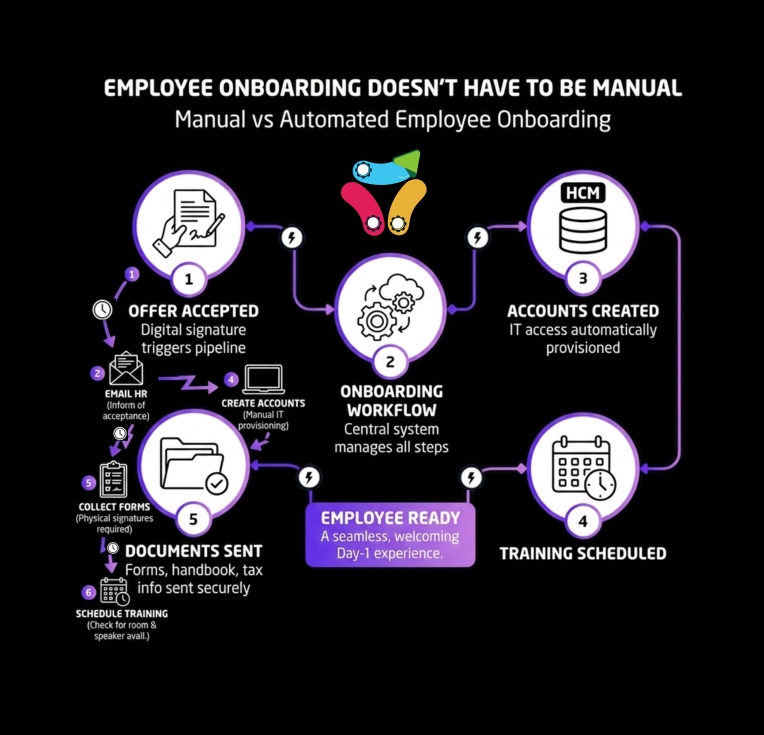
Employee onboarding doesn’t have to be manual.
Every New Hire Triggers a Workflow
When a new employee joins, dozens of activities typically happen behind the scenes.
For example:
- Create company email accounts
- Set up software access
- Prepare employment documents
- Create employee records
- Assign training materials
- Schedule onboarding meetings
- Notify managers and team members
- Request equipment and licenses
These steps may involve HR, IT, Operations, Finance, and department managers.
The challenge is not the tasks themselves.
The challenge is coordinating them consistently every single time.
The Problem With Manual Onboarding
Many onboarding processes evolve naturally over time.
Someone creates a checklist.
Someone sends an email.
Someone remembers to notify IT.
Someone updates a spreadsheet.
And eventually, everyone assumes the process works.
Until something gets missed.
A new employee arrives without access to critical systems.
Training documents are forgotten.
Equipment isn’t ready.
Managers assume someone else completed a task.
The new hire’s first impression becomes frustration instead of confidence.
Employee Experience Starts Before Day One
Many businesses focus on onboarding after the employee starts.
In reality, onboarding begins the moment an offer is accepted.
A smooth process helps new employees feel:
- Welcomed
- Organized
- Supported
- Confident
A disorganized process creates the opposite experience.
Employees quickly notice when internal systems are confusing or inconsistent.
And first impressions often shape long-term engagement.
The Workflow Approach
Instead of treating onboarding as dozens of separate tasks, treat it as one connected workflow.
For example:
Step 1: New Hire Form Submitted
HR completes a simple onboarding form containing:
- Employee information
- Start date
- Department
- Manager
- Required systems
Step 2: Tasks Are Generated Automatically
The workflow creates:
- IT setup requests
- Equipment requests
- Training assignments
- Manager notifications
Step 3: Documents Are Prepared
Employment forms, policies, and onboarding materials are organized automatically and made available to the employee.
Step 4: Progress Is Tracked
Everyone involved can see:
- What has been completed
- What is still pending
- Who owns each task
Step 5: Day One Is Ready
The employee arrives with the tools, access, and information they need to be productive.
Why Consistency Matters
The goal isn’t simply saving time.
Consistency is equally important.
A repeatable onboarding process ensures:
- Every employee receives the same information
- Important steps are not forgotten
- Managers know their responsibilities
- HR spends less time chasing updates
- New hires have a better experience
Consistency becomes even more valuable as the company grows.
Employee Onboarding Is a Perfect Candidate for Automation
Not every business process should be automated.
Employee onboarding is one of the strongest candidates because it follows predictable steps.
Every new hire triggers similar activities.
The information is structured.
The responsibilities are clear.
The outcomes are repeatable.
This makes onboarding an ideal workflow for forms, task automation, notifications, approvals, and process tracking.
Better Systems Support Better People
One of the biggest misconceptions about automation is that it’s only about efficiency.
In reality, well-designed systems improve the experience for everyone involved.
HR teams spend less time on administrative work.
Managers gain better visibility.
IT receives clearer requests.
Employees start their roles with fewer obstacles.
Everyone benefits.
Start With One Repeatable Process
If your onboarding process relies heavily on emails, spreadsheets, and manual follow-ups, there is likely an opportunity to simplify it.
Start by documenting:
- What triggers onboarding
- Which teams are involved
- What information is required
- What tasks happen every time
Once the process is visible, opportunities for improvement become much easier to identify.
Because employee onboarding shouldn’t depend on memory.
It should depend on a system.
Ready to Simplify Employee Onboarding?
Employee onboarding is one of the most common internal workflows businesses automate because the benefits are immediate.
A Workflow Audit can help identify repetitive onboarding tasks, bottlenecks, and opportunities to create a smoother experience for both your team and your new employees.