Growth problems don’t always look like growth problems.
Many business owners assume they need more customers, more employees, or more software to move their business forward.
In reality, some of the biggest barriers to growth are hidden inside everyday administrative work.
The emails.
The spreadsheets.
The updates.
The approvals.
The status checks.
The countless small tasks that quietly consume hours every week.
Individually, these activities don’t seem significant.
Collectively, they can slow an entire business down.
The Problem Isn’t the Work
Administrative work is necessary.
Customers need onboarding.
Teams need communication.
Projects need updates.
Records need to be maintained.
The issue isn’t that these tasks exist.
The issue is that many businesses continue performing them manually long after they become repetitive.
As the business grows, administrative effort grows with it.
What once took a few minutes now consumes several hours every week.
The Hidden Tax on Growth
Every repetitive administrative task creates a small tax on the business.
Consider a simple client onboarding process.
A new customer signs.
Someone creates folders.
Someone sends welcome emails.
Someone updates the CRM.
Someone creates tasks.
Someone notifies the delivery team.
None of these activities are difficult.
But they all require time.
When the process is repeated dozens or hundreds of times, the cost becomes substantial.
The business isn’t just spending time serving customers.
It’s spending time managing the process of serving customers.
Growth Creates More Complexity
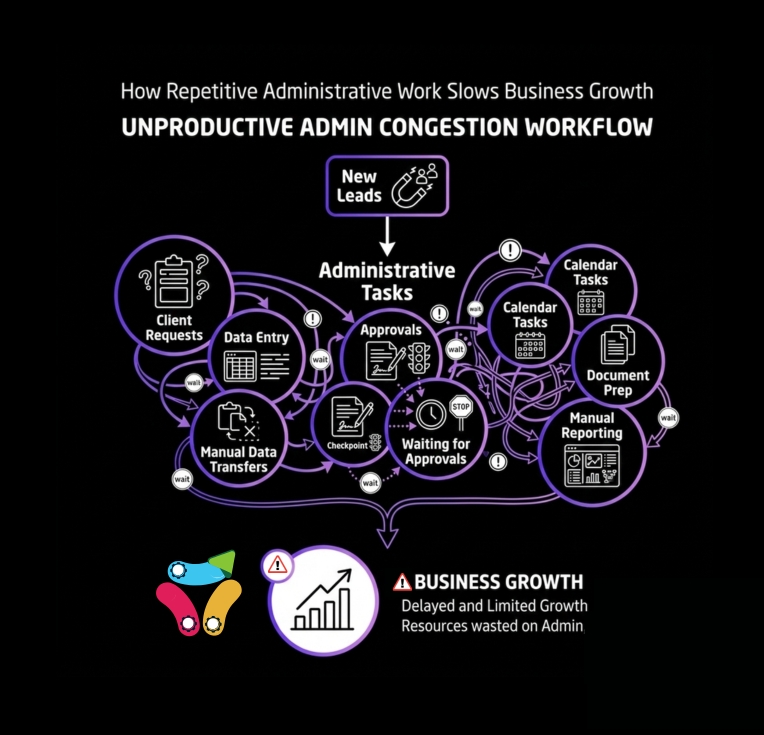
This is why many businesses feel busier without feeling more productive.
As customers increase, so does operational complexity.
More requests.
More approvals.
More updates.
More communication.
Without clear systems, the workload expands faster than the business can comfortably manage.
Many owners respond by hiring more people.
Unfortunately, adding people to a complicated process often creates more complexity rather than less.
Administrative Work Steals Focus
The real cost isn’t only the time spent completing tasks.
It’s the interruption.
Every administrative activity pulls attention away from higher-value work.
Sales conversations.
Customer relationships.
Strategic planning.
Product development.
Problem solving.
The activities that actually move the business forward.
Small interruptions repeated throughout the day can significantly reduce productivity and focus.
The Most Common Administrative Bottlenecks
Across different industries, the same patterns appear repeatedly.
Manual Data Entry
Updating multiple systems with the same information.
Internal Requests
Approvals and requests managed through email or chat.
Reporting
Compiling information manually from different sources.
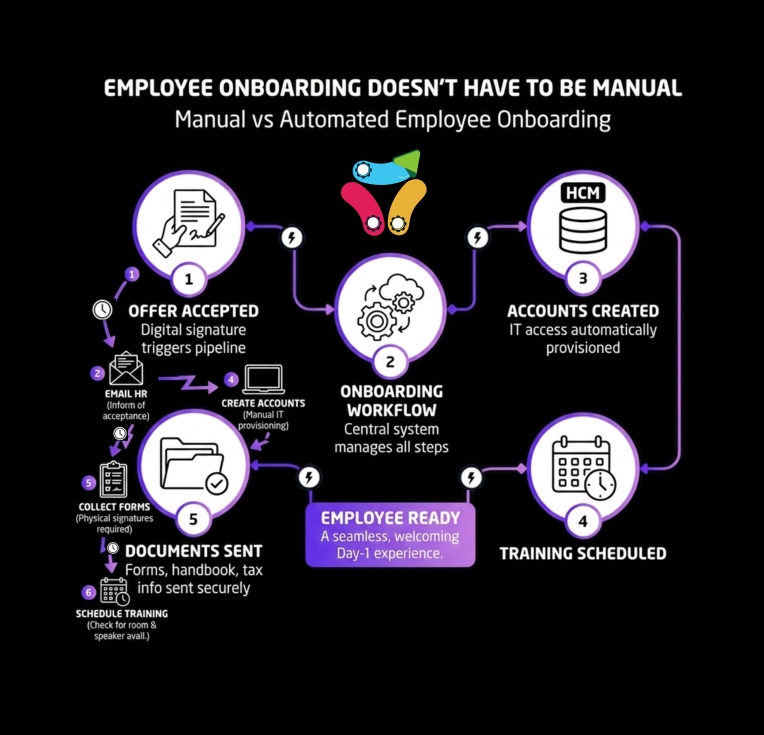
Employee Onboarding
Creating accounts, documents, and access permissions manually.
Customer Onboarding
Repeating the same setup process for every new client.
These processes are important, but they are often highly repetitive.
Better Systems Create Capacity
Many business owners believe growth requires more effort.
Often, growth requires better systems.
When repetitive administrative work is reduced:
- Teams respond faster
- Errors decrease
- Information becomes easier to find
- Processes become more consistent
- Employees focus on higher-value work
Most importantly, the business gains capacity without immediately increasing headcount.
The Goal Is Not More Automation
Automation is not the objective.
Efficiency is.
Sometimes the answer is automation.
Sometimes it’s documentation.
Sometimes it’s redesigning a process.
What matters is removing unnecessary friction.
The businesses that scale successfully are not necessarily the ones working harder.
They’re the ones creating systems that allow work to flow more smoothly.
Start With Your Most Repetitive Task
If you’re looking for opportunities to improve operations, start by identifying one repetitive activity that happens every day.
Ask yourself:
- Does this task follow the same steps each time?
- Could it be documented?
- Could part of it be delegated?
- Could part of it be automated?
Small improvements compound quickly.
And in many cases, reducing repetitive administrative work is one of the fastest ways to create capacity for growth.
Because growth shouldn’t require more chaos.
It should require better systems.
Ready to Identify Operational Bottlenecks?
A Workflow Audit helps uncover repetitive administrative work, process bottlenecks, and opportunities to simplify the way your business operates.
The goal isn’t to automate everything.
It’s to make growth easier.