The Hidden Cost of Manual Work: Where Small Businesses Lose 5+ Hours Every Week
Most business owners don’t realize how much time they lose every week.
Not because they’re unproductive.
Not because their team isn’t working hard.
But because small amounts of manual work quietly accumulate throughout the day.
A few minutes updating spreadsheets.
A few minutes copying information between systems.
A few minutes following up on tasks.
A few minutes searching for documents.
A few minutes creating reports.
Individually, these tasks seem insignificant.
Collectively, they create hours of lost productivity every week.
And for growing businesses, those hours become one of the biggest obstacles to scaling efficiently.
The Problem Isn’t the Big Tasks
Most business owners focus on major projects, customer meetings, sales activities, and strategic decisions.
The hidden cost comes from the smaller tasks happening in the background.
Consider a typical day:
- Updating customer information in multiple systems
- Sending onboarding documents manually
- Creating calendar invitations
- Following up on outstanding requests
- Moving files between applications
- Updating reports and spreadsheets
- Checking whether tasks have been completed
None of these tasks are particularly difficult.
The problem is repetition.
Every time a process relies on someone manually moving information from one place to another, time is lost.
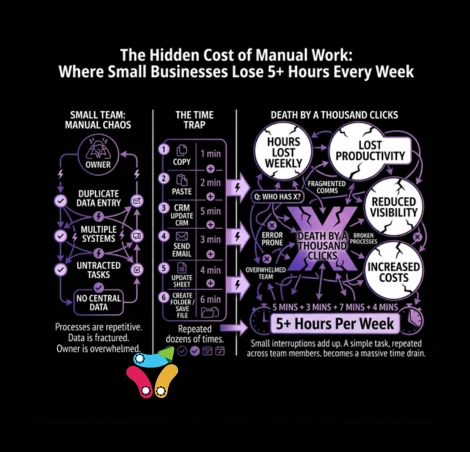
Death by a Thousand Clicks
Many operational inefficiencies don’t look serious on their own.
A CRM update takes two minutes.
Sending a follow-up email takes three minutes.
Updating a spreadsheet takes another minute.
Saving documents takes another two minutes.
By the end of the day, dozens of small actions have consumed valuable time.
Now multiply that across a team.
Then multiply it across an entire year.
The cost becomes much larger than most business owners expect.
More importantly, these repetitive activities often interrupt higher-value work that requires focus and expertise.
Where Most Businesses Lose Time
While every business is different, certain bottlenecks appear repeatedly.
Client Onboarding
New clients often trigger multiple manual tasks:
- Creating documents
- Sending welcome emails
- Updating CRM records
- Creating project folders
- Assigning internal tasks
These activities are important but often highly repetitive.
Lead Management
Leads arrive through websites, social media, referrals, and contact forms.
Without a clear workflow, teams often spend time:
- Collecting information manually
- Updating records
- Assigning leads
- Sending follow-up communications
The result is inconsistent follow-up and missed opportunities.
Scheduling and Coordination
Many businesses spend more time scheduling meetings than conducting them.
Back-and-forth emails, reminders, calendar updates, and event coordination can consume surprising amounts of time.
Reporting and Administration
Weekly reports, status updates, spreadsheet maintenance, and data entry are common sources of operational friction.
These tasks often provide valuable information but require significant manual effort to maintain.
The Hidden Cost Isn’t Just Time
Most discussions about efficiency focus on time savings.
But manual work creates other problems too.
Human Error
The more times information is copied and pasted, the greater the risk of mistakes.
Incorrect data can affect reporting, customer communication, and decision-making.
Delays
Manual processes depend on people being available.
When workloads increase, delays become more common.
Inconsistency
Different employees may perform the same process differently, creating inconsistent customer experiences.
Team Frustration
Very few people enjoy repetitive administrative work.
When employees spend too much time on routine tasks, engagement and productivity often suffer.
Why More Software Isn’t Always the Answer
When businesses identify inefficiencies, their first instinct is often to purchase another tool.
Unfortunately, additional software can sometimes create more complexity rather than less.
A new platform still requires:
- Setup
- Training
- Maintenance
- User adoption
- Ongoing management
The better approach is usually to improve the workflow before introducing new technology.
Start by understanding how work moves through your business.
Identify repetitive steps.
Find bottlenecks.
Then determine which activities can be simplified, automated, or delegated.
The Workflow Perspective
At AdvForLess, we view businesses through workflows rather than software.
A workflow is simply a sequence of actions that complete a business process.
For example:
- A client submits a form
- Documents are personalized
- Files are stored
- The client receives an email
- CRM records are updated
- Internal teams are notified
Many businesses perform these steps manually.
Others connect the process into a streamlined workflow that requires little ongoing effort.
The difference can save hours every week.
How to Find Your First Five Hours
If you want to identify opportunities in your own business, start by asking:
- Which tasks happen every day?
- Which tasks involve copying information?
- Which tasks require the same actions repeatedly?
- Which tasks are easy but time-consuming?
- Which tasks create frustration for the team?
These activities often represent the highest-value opportunities for improvement.
You don’t need to automate everything.
You simply need to identify the repetitive work that delivers the biggest return when simplified.
The Goal Is Simplicity
The objective isn’t to eliminate people from your processes.
The objective is to eliminate unnecessary work.
When repetitive tasks are reduced, teams can focus on:
- Serving customers
- Building relationships
- Solving problems
- Creating value
- Growing the business
That’s where real productivity gains happen.
And for many businesses, reclaiming just five hours every week is enough to create meaningful momentum.
The challenge isn’t working harder.
It’s removing the friction that’s quietly slowing your business down every day.
Ready to Find Your Hidden Bottlenecks?
Most businesses already have opportunities to save time using the tools they own today.
The first step is identifying where manual work is creating unnecessary friction.
That’s exactly what a Workflow Audit is designed to uncover.