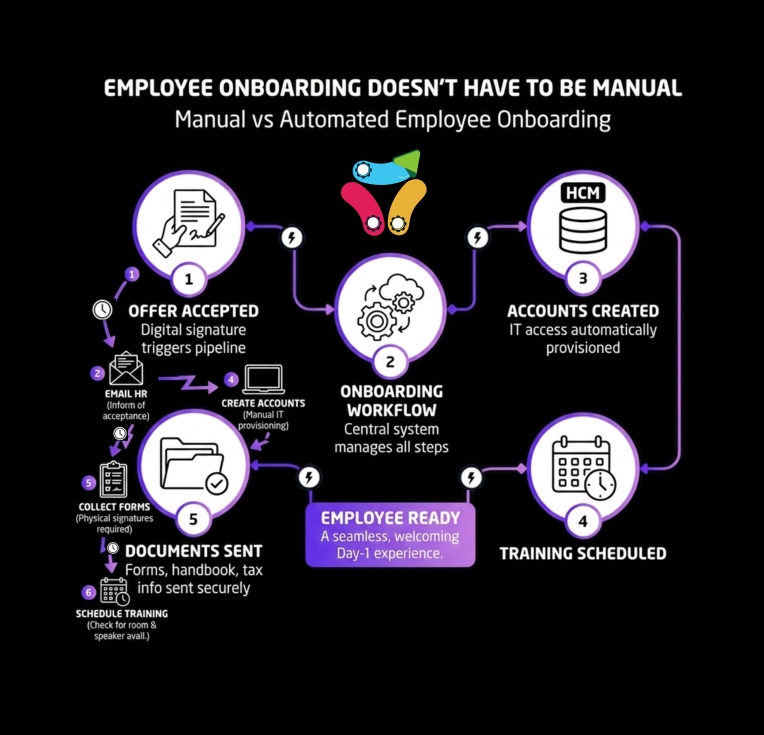
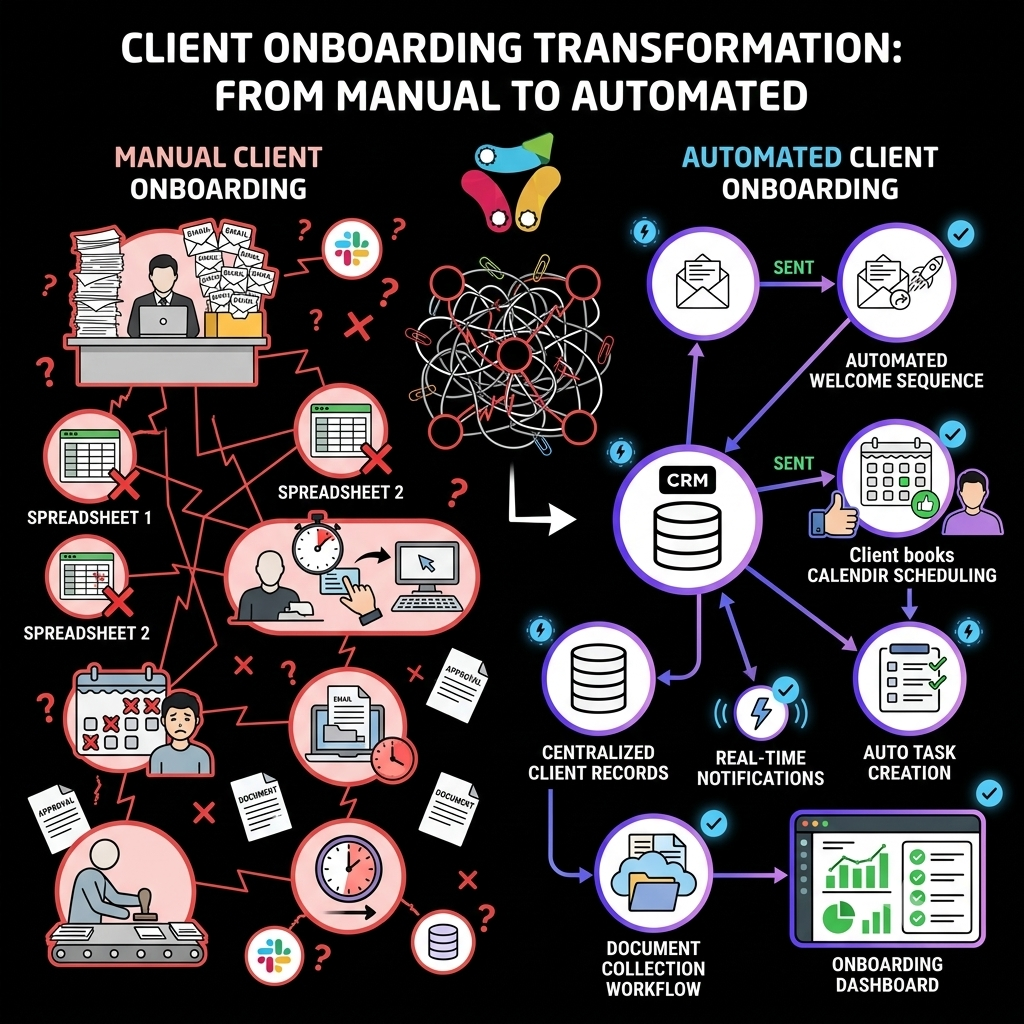
Most businesses underestimate how much time they spend onboarding new clients.
After all, each task only takes a few minutes.
Send an email.
Create a folder.
Update the CRM.
Generate documents.
Notify the team.
Schedule a kickoff meeting.
Individually, these tasks seem small.
Collectively, they create one of the biggest operational bottlenecks in growing businesses.
Every New Client Creates Work
A new customer should feel exciting.
Unfortunately, many businesses experience something different:
Administrative overload.
The more clients they acquire, the more manual work accumulates behind the scenes.
Growth starts creating stress instead of momentum.
Where Time Gets Lost
Manual onboarding often includes:
- Creating client records
- Sending welcome communications
- Preparing documents
- Creating project folders
- Updating spreadsheets
- Scheduling meetings
- Assigning internal tasks
Each step requires attention.
Each step creates opportunities for delay.
Each step increases the likelihood of mistakes.
The Cost Isn’t Just Time
Manual onboarding creates additional challenges:
Delayed Response Times
Clients wait longer for information.
Inconsistent Experiences
Different clients receive different onboarding experiences.
Team Frustration
Employees spend time on repetitive administrative work.
Missed Opportunities
Time spent onboarding manually is time not spent growing the business.
The Scaling Problem
Many businesses discover that onboarding becomes harder as they grow.
The process that worked with five clients struggles with fifty.
Not because the team is incapable.
Because the workflow was never designed to scale.
Better Systems Create Better Growth
A streamlined onboarding workflow ensures:
- Faster response times
- Consistent customer experiences
- Reduced administrative work
- Better visibility across teams
Most importantly, it allows businesses to grow without proportionally increasing administrative effort.
Client Growth Shouldn’t Create Operational Chaos
The businesses that scale successfully aren’t necessarily working harder.
They’re creating systems that support growth from the start.